|
Joker Recommends
|
-Top 20 List
-House of Flying Daggers
-The Aviator
-Bad Education
|
|
Yun-Fat Recommends
|
|
-Eight Diagram Pole Fighter
-Los Muertos
-Tropical Malady
|
|
Allyn Recommends
|
|
-Eternal Sunshine of the Spotless Mind
-Songs from the Second Floor
|
|
Phyrephox Recommends
|
-Top 20 List
-Design for Living (Lubitsch, 1933)
-War of the Worlds
-Howl's Moving Castle
|
|
Melisb Recommends
|
-Top 20 List
-The Return
-Spirited Away
-Spring, Summer, Fall, Winter...And Spring
|
|
Wardpet Recommends
|
|
-Finding Nemo
-Man on the Train
-28 Days Later
|
|
Lorne Recommends
|
|
-21 Grams
-Cold Mountain
-Lost in Translation
|
|
Merlot Recommends
|
-Top 20 List
-The Man on the Train
-Safe Conduct
-The Statement
|
|
Whitney Recommends
|
|
-Femme Fatale
-Gangs of New York
-Grand Illusion
|
|
Sydhe Recommends
|
|
-In America
-Looney Tunes: Back In Action
-Whale Rider
|
|
Copywright Recommends
|
Top 20 List
-Flowers of Shanghai
-Road to Perdition
-Topsy-Turvy
|
|
Stennie Recommends
|
Top 20 List
-A Matter of Life and Death
-Ossessione
-Sideways
|
|
Jeff Recommends
|
|
-Dial M for Murder
-The Game
-Star Wars Saga
|
|
Lady Wakasa Recommends
|
|
-Dracula: Page from a Virgin's Diary
-Dr. Mabuse, Der Spieler
-The Last Laugh
|
|
Steve Recommends
|
-Top 20 List
-Princess Raccoon
-Princess Raccoon
-Princess Raccoon
|
|
Jenny Recommends
|
|
-Mean Girls
-Super Size Me
-The Warriors
|
|
Lons Recommends
|
|
-Before Sunset
-The Incredibles
-Sideways
|


|
(c)2002 Design by Blogscapes.com
|
The Blog:
|
Question of the Week: Recommendations
Merlot had a good idea. In a couple of weeks we will continue with the "Unofficial Milk Plus Canon" for the years 1975-79, and she suggested that as a form of prep we create a column in which we could suggest some lesser known films from that era. With that in mind, here is this new "Question of the Week":
Suggest a film released during the 1975-79 time period that you think we should all watch before the next Milk Plus Canon poll. Just write a sentence of two as to why you think we should watch it.
Please make sure that these films are either readily available on DVD/VHS or being screened as part of a widely available touring retrospective. As always, this question is open to all blog members and readers, and feel free to make as many suggestions as you wish. If you feel like it, you can also use this comments section to write a review of one of these movies (blog members can also feel free to write a new post).
Short Takes
Just a couple of short thoughts on some of the movies that I saw this weekend. Some of us did not get to go to Toronto or Venice this year (I’m not bitter or anything):
Sky Captain and the World of Tomorrow (d. Kerry Conran) - Oh sweet jesus, was this movie boring. I mean, I saw what they were going for, an homage to 30s adventure serials and comic books, and I can appreciate that, but man, was it flat, and I don’t just mean Gwyneth Paltrow’s acting throughout the film. Despite some beautiful visuals, interesting production design, and occasional moments (the initial sequence of the zeppelin docking at the Empire State Building, Michael Gambon silhouetted against the massive Art Deco-style window), most of which were actually comedic (when they wake up together in Shangri-la), Sky Captain and the World of Tomorrow really doesn’t have much of a story, being much more of a group of strung-together would-be climaxes which do not have much impact, being that the digital danger seemed especially remote. And the acting, phew! The long-dead Laurence Olivier gave the most inspired performance of the film, perhaps because he did not have the challenge of acting exclusively against a blue screen, but it’s nice to know that Bai Ling has cornered the market on mysteriously dangerous Asian women roles. Bonus points to anyone who can identify the most glaring historical continuity error in the film (a no, the amphibious P-40 Warhawk doesn’t count). Here’s a hint, its a bit of dialogue spoken by Polly Perkins.
Special Note: I know that many of you don’t care anymore, but the original Star Wars trilogy was released on DVD. Check out the many more changes here, especially the screenshots, some of it is funny shit. George Lucas must be stopped; I mean, I was going to see THX-1138 until I heard that it was retouched by the metteur en scene.
Mr. 3000 (d. Charles Stone III) - After Sky Captain and the World of Tomorrow comes the real fantasy! The Milwaukee Brewers in a pennant race in 1995, HA-HA-HA! (I’ve edited out my continuing guffawing for the sake of brevity). Mr. 3000 is a slight but amusing film, pretty much carried by Bernie Mac’s performance. Its funny, and has some moments, mainly in the many dugout sequences, and Paul Sorvino, who plays the Brewers manager, has one great scene. Its never really laugh out loud funny, but its a passable way to spend your time.
Wimbledon (d. Richard Loncraine) - Two sports-themed movies in a row. What a day. Wimbledon may have never met a sports cliché it didn’t like, and Kirsten Dunst gives some less than convincing line readings, but it is a good film, all because of Paul Bettany, who infuses his starring role as an “aging” tennis pro playing his last tournament with such good humor and romanticism that you can not help but root for him on the court and in his relationship with the rising tennis star played by Dunst (quite literally, the sparse audience I attended the film with were clapping for him during the Wimbledon finals). You will probably see Bettany among my Droogies nominations later this winter.
Outfoxed: Rupert Murdoch’s War Against Journalism (d. Robert Greenwald) - I saw this one for free, and despite the uber-cheesey computer graphics, it was an interesting film, even though I pretty much was familiar with all the points made during the documentary (you know, I did see Fahrenheit 9/11 and The Corporation). Still, since I isolate myself from Fox News as much as possible, the exposure to such right-wing assholes like Sean Hannity and Bill O’Reilly (Holy Crap, what an insane shit bag) made my skin crawl. The one real problem with the film is the ending, because the film suddenly expands its focus from Fox News, lurching to encompass all of the corporate-owned media, but the analysis is rushed and somewhat facile.
Bully (d. Larry Clark) - Probably my favorite film of the weekend, which I watched on DVD. In my opinion, a much better portrait of adolescent malaise (both moral and physical) than his earlier, and rawer, Kids ( Bully is definitely more polished, and its interesting that the DVD provides the actual mug shots of the many characters so that you can compare and contrast them with the actors. Big difference, especially Bijou Philips and Rachel Miner’s characters). Based on a true story, Bully is a succession of scenes featuring a group of Florida teenagers fucking, getting high, and driving around doing nothing. That, and they also almost casually plot the death of the violent local alpha male played by Nick Stahl. The drug addled brain trust made it pretty easy on the cops, and the whole thing would be so ridiculous if it were not so brutal. Clark casts a wide net, seeming to indict hip-hop music, video games, and drugs, but its the various parents who are either willfully ignorant of their children’s problems or flaws who come in for the most pummeling.
Oh, by the way, I’m no longer a solely self-published critic, check out my review of Goodbye, Dragon Inn at Flak Magazine.
Goodbye, Dragon Inn “Half bitter, half sweet,” swoons Yao Lee over the closing credits of Goodbye, Dragon Inn, and it is a elucidation as simple as it is evocative of Taiwanese director Tsai Ming-Liang’s filmmaking. Tsai has continued to refine his talent at a placid, Ozu-like pace, and his latest film evokes that of the Japanese master: formal but not alienating, heartfel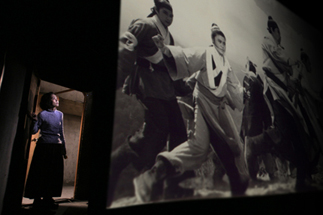 t but not manipulative, and above all gently elegiac with a rich, subdued sense of humor. Its focus, like most of Tsai’s oeuvre, is of human (dis)connection, and by draining the narrative to a poetic minimalism and tying his themes to the unusual subject of cinema attendance, Tsai has fashioned a delicate film glowing of melancholy over the state of cinema and the ephemerality of human amity. t but not manipulative, and above all gently elegiac with a rich, subdued sense of humor. Its focus, like most of Tsai’s oeuvre, is of human (dis)connection, and by draining the narrative to a poetic minimalism and tying his themes to the unusual subject of cinema attendance, Tsai has fashioned a delicate film glowing of melancholy over the state of cinema and the ephemerality of human amity.
Goodbye, Dragon Inn honors the closing of an old Taiwanese movie theatre. Its last screening is of King Hu’s Dragon Inn, and the martial-arts classic goes all but unseen in the cavernous, dilapidated, leaky theatre. The crowd is small and sporadic. Tsai is clearly honoring not just a different age of filmmaking but a different age of film going-the film’s first scene is either a fantasy or a flashback of Dragon Inn playing to a packed and rapturous audience. But, as sad as it is to witness a minute moment in the passing of classic cinema, it is even more remarkable how unexplored the topic of the spectatorship and community of movie going is, for Goodbye, Dragon Inn is most purely an off-beat, reverent poem to theatre 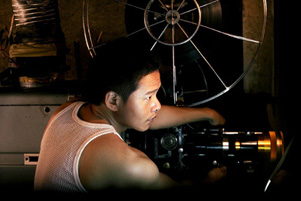 audiences. audiences.
Those in attendance at the screening late in the rainy evening are few-an old man and his grandson, a young Japanese tourist looking for companionship alternatively in Hu’s movie and in the theatre audience, and a handful of various apparitions. In one of only two conversations in the entire film, a pensive, well dress man warns the tourist that the theatre is haunted by ghosts, a beautiful, sad description of the dwindled audience. Tsai playfully teases the tourist when a woman seated on the other side of the theatre noisily eating nuts disappears only to reappear behind him, crunching mechanically while captivated by the movie and scaring wits out of the man. Many moments are equally mischievous-a man picking the seat right next to the tourist with the whole of the empty theatre to choose from, the constant interruptions of smoking, bathroom calls, and exits, entrances, and reseatings. The movie theatre appears here as only a temporary rest stop and certainly nothing worth staying in your seat forever for; the sadness of movie and its audience as a completely transitory situation. On a more melancholic note are two more “ghost” attendees, the old man played by Tsai’s regular father figure Tien Miao and Shih Chun-both actors playing themselves, attending a sad, half-hearted revival of a film they both appeared in nearly forty years earlier. Both of them stay for t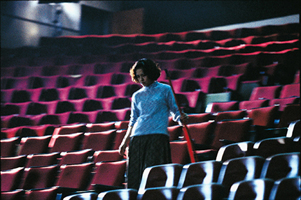 he entire show, as if leaving midway through would somehow be a breach of etiquette, the shaming of a memory or a life. he entire show, as if leaving midway through would somehow be a breach of etiquette, the shaming of a memory or a life.
While the cavernous theatre with its empty red velvet seats is the thematic and spatial centerpiece of the film, the utility passages that entwine the screening room have stories of their own. Sadly and somewhat erotically shuffling around the hidden passages, creaky corners, multiple stairways, and flooded halls is the theatre’s disabled ticket woman (Shiang-chyi Chen). She finds little solace in the repetitious duties of her position, and journeys a long way upstairs to give the projectionist (Kang-shen Lee) something special for supper, only to find the room empty but for the sound of the whirling film reels. Later, joy momentarily spills on her face when she sneaks behind the theatre’s screen and watches as a martial heroine elegantly repels several attackers with her swordsmanship, the light popping through the screen’s perforated canvas onto the enraptured face of the sad employee, like a meteor shower of cine-light.
Tsai composes cinematographer Ben-Bong Liao’s textured, precise images like still photographs that glow from their own mystery, the length of each take resting plaintively on the senses of simultaneous kinship and alienation in a movie house, the arbitra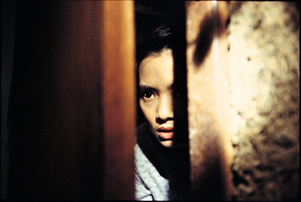 riness and solemnity of the audience’s watchful gaze. The narrative is minimal and Dragon Inn does more talking than any of Tsai’s sorrowful characters. Later, Tien Miao laments to his fellow actor that no one goes to see movies anymore, and one hopes that Dragon Inn’s turnout, however small, found some sort of meaning in the screening. Gradually what seems clear is that the importance may not be the film itself. While eulogizing Hu’s bygone era of filmmaking and sadly condemning our era’s appreciation of lost classics, the despair and the hope in Tsai’s film is the unusual interaction, or lack of it, in the theatre’s receding audience. It is in the tentative, elided connection between the male and female theatre employees, the silly, common jokes about weird and obnoxious audience members, and in the strange male wanderings and their restroom comradery. The effect is quiet, minimal, and delivered in a sweet, graceful tone that Yao Lee invokes so well in her now-nostaglic pop lyrics: “Half bitter, half sweet.” It describes the film itself, and it equally describes a look back at what cinema used to be and a look presently to see what it has become. riness and solemnity of the audience’s watchful gaze. The narrative is minimal and Dragon Inn does more talking than any of Tsai’s sorrowful characters. Later, Tien Miao laments to his fellow actor that no one goes to see movies anymore, and one hopes that Dragon Inn’s turnout, however small, found some sort of meaning in the screening. Gradually what seems clear is that the importance may not be the film itself. While eulogizing Hu’s bygone era of filmmaking and sadly condemning our era’s appreciation of lost classics, the despair and the hope in Tsai’s film is the unusual interaction, or lack of it, in the theatre’s receding audience. It is in the tentative, elided connection between the male and female theatre employees, the silly, common jokes about weird and obnoxious audience members, and in the strange male wanderings and their restroom comradery. The effect is quiet, minimal, and delivered in a sweet, graceful tone that Yao Lee invokes so well in her now-nostaglic pop lyrics: “Half bitter, half sweet.” It describes the film itself, and it equally describes a look back at what cinema used to be and a look presently to see what it has become.
Ghost in the Shell 2: Innocence Mamoru Oshii is probably the only director in the world who makes art films under the guise of traditional anime. While Ghost in the Shell 2: Innocence-Oshii’s sequel to the shrewd 1995 philosophic sci-fi rumination cum thriller-is indeed animated and indeed adheres to what one may call a conventi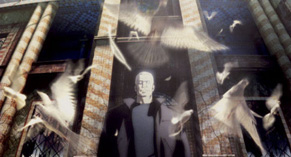 onal anime science-fiction future, the similarities between Oshii’s film and standard Japanese animation ends here. Like the film before it, Innocence is obsessed with the binary separation between man and machine, and more specifically the issues raised in the future when humans, enhanced by cybernetic upgrades, cross the line between man and machine and refer to the traces of a soul in a mechanical body as a “ghost.” The ghost in Oshii’s own machine is often difficult to find. Like the cyborgs that inhabit the film, Innocence raises astute, highly intelligent questions about the man/machine binary, and like those cyborgs the film asks whether something as inorganic as a machine or a enervated, constructed film can bare evidence of a soul. onal anime science-fiction future, the similarities between Oshii’s film and standard Japanese animation ends here. Like the film before it, Innocence is obsessed with the binary separation between man and machine, and more specifically the issues raised in the future when humans, enhanced by cybernetic upgrades, cross the line between man and machine and refer to the traces of a soul in a mechanical body as a “ghost.” The ghost in Oshii’s own machine is often difficult to find. Like the cyborgs that inhabit the film, Innocence raises astute, highly intelligent questions about the man/machine binary, and like those cyborgs the film asks whether something as inorganic as a machine or a enervated, constructed film can bare evidence of a soul.
The stoic Section 9 investigator Batou returns in the sequel sans Major Kusanagi -the cybernetic female heroine of the original who transcends the limitations of her flesh and robotics-and follows the familiar detective path of banal crime that inevitably unfolds into a questioning of technological and religious philosophy. In the first film the criminal was a rogue program that drew attention to itself through renegade hacking in order to merge with an entity containing a ghost. In the sequel the crimes are only slightly less dry-various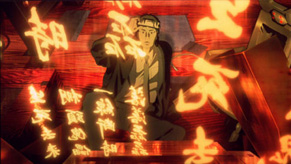 dolls of the same model and make, illegally created and used for sexual activities, have recently assumed ghosts of their own, thereby gaining self-awareness and the ability to override robot ethical codes and harm humans. dolls of the same model and make, illegally created and used for sexual activities, have recently assumed ghosts of their own, thereby gaining self-awareness and the ability to override robot ethical codes and harm humans.
With an overwhelming consistency, and with a technique that deepens the films meaning at the same time it impairs the film’s entertainment and narrative value, Oshii attacks the simplicity of the human-machine separation, a binary system that reveals endless complexities and convolutions inherent in Innocence itself. Engaging the film is not so much engaging a story, rather it is an exploration of the themes Oshii inelegantly hardwires into the narrative.
The most startling of this engagement of human/machine distortion is within the style of the film. Like many current anime works, Oshii uses both traditional two-dimensional animation and compliments (and sometimes supplements) its limitations with three-dimensional computer animation. In most films the result is tacky and obvious; the two techniques generally do not blend together 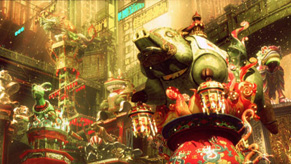 well and produce an alienating effect. It is no different in Innocence, but the ungainly visual look is one of a myriad of visual cues Oshii provides to reveal the mystery of his themes. For this aspect, the traditional animation, though less realistic looking, has an organic and fluid feel, while the newer computer animation has a inert, artificial lifelessness that convolutes the fact that its very dimensionality should make it appear more natural. This is only one example in a film that contains what seems a near endless amount of engagements with the blurring between man and machine. Others pop up with greater frequency than actual plot elements: the artificial reality of hacked human memory vs. what one presumes are organic perceptions (and the implications of this in movie watching); the idea of a robot keeping a pet and being loved by it; the possibility that an infinitely flexible and omniscient free-willed information based entity could function as a god, etc., etc., and so on. well and produce an alienating effect. It is no different in Innocence, but the ungainly visual look is one of a myriad of visual cues Oshii provides to reveal the mystery of his themes. For this aspect, the traditional animation, though less realistic looking, has an organic and fluid feel, while the newer computer animation has a inert, artificial lifelessness that convolutes the fact that its very dimensionality should make it appear more natural. This is only one example in a film that contains what seems a near endless amount of engagements with the blurring between man and machine. Others pop up with greater frequency than actual plot elements: the artificial reality of hacked human memory vs. what one presumes are organic perceptions (and the implications of this in movie watching); the idea of a robot keeping a pet and being loved by it; the possibility that an infinitely flexible and omniscient free-willed information based entity could function as a god, etc., etc., and so on.
As Batou and his human partner Togusa get more tangled up in the investigation to find the source of the dolls’ souls, the film takes on a near-lifeless, brooding philosophic atmosphere. The stillness of the film comes as a constant surprise; Oshii takes 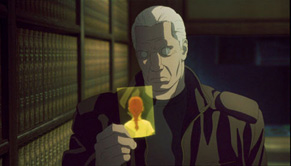 many moments for deadpan reactions and silent inaction that belays any sense of the characters’ contemplations. Often, little effort is exerted to elaborating the mise-en-scene. Instead, the staid drama of the film once again fuels its thematics. The fact that the human and emotive Togusa, a family man with a wife and a daughter, wants no part of the philosophic questions the investigation turns up is all the more confounding when Batou, an inert expressionless being who is more machine than man, actively seeks answers to the questions of life. Through a unique kind of thematic loophole Oshii has found a subject for his film that contains within the abilities to conquer criticism about the film itself. many moments for deadpan reactions and silent inaction that belays any sense of the characters’ contemplations. Often, little effort is exerted to elaborating the mise-en-scene. Instead, the staid drama of the film once again fuels its thematics. The fact that the human and emotive Togusa, a family man with a wife and a daughter, wants no part of the philosophic questions the investigation turns up is all the more confounding when Batou, an inert expressionless being who is more machine than man, actively seeks answers to the questions of life. Through a unique kind of thematic loophole Oshii has found a subject for his film that contains within the abilities to conquer criticism about the film itself.
That the film offers a hero with no charismatic power, for whom no effort is put into to develop emotions, facial expressions, or any kind of empathy, Oshii invests the soul of a lost philosopher (as well as a dog lover). Likewise exists a world of the future-populated only by white-collar policemen, faceless criminals, soulless robots, and dreamy pseudo- philosophers-that has no depth of realism, little humanity, and barely an organic presence. The remarkable non-narrative montage of the organically decaying Asian metropolis in Ghost in the Shell spoke more for humanity than Innocence’s golden computer-generated Asian festival, replete with artificial gloss and color. This is a sad, dreary world that has been wrought by confusing man and machine, and the film itself is just as grave and inert in its combinations-2d/3d; anime conventions and that of the art film; sci-fi thriller and sprawling intellectual musing. And in this confusion lies both its depth and its near-tedium.
The sheer intellectual richness and complexity of Innocence is overwhelming, and all the more so because i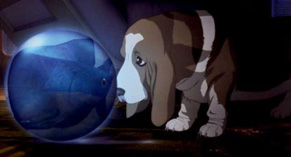 t is so accessible and displayed on a surface level. Something as conventional as using “futuristic” graphical overlays, graphs, models, and representations on the screen becomes yet another layer of mechanical representation of an organic reality. A gun battle at the beginning of the film has Batou mowing down human yakuza, and at the end of the film he guns down an equal amount of lifeless dolls. Do these dolls have souls? Does it make a difference for Batou? For the film viewer? The doll motif is a key one for Oshii, who ties the dolls narrative of Batou’s investigation into questioning the rearing of children, the keeping of pets, and the issues wrought in the first film how DNA might just be a complicated data program bent on re-creation instead of mere copying. t is so accessible and displayed on a surface level. Something as conventional as using “futuristic” graphical overlays, graphs, models, and representations on the screen becomes yet another layer of mechanical representation of an organic reality. A gun battle at the beginning of the film has Batou mowing down human yakuza, and at the end of the film he guns down an equal amount of lifeless dolls. Do these dolls have souls? Does it make a difference for Batou? For the film viewer? The doll motif is a key one for Oshii, who ties the dolls narrative of Batou’s investigation into questioning the rearing of children, the keeping of pets, and the issues wrought in the first film how DNA might just be a complicated data program bent on re-creation instead of mere copying.
Under the weight of so many themes wrought of a simple binary, Innocence’s endorsement of humanity at the end may seem like a dim hope that life may return to the film. That this life seems purposeless and continually sucked out of Innocence is ironic as the film so thoroughly engages questions about the nature of life itself. How can such a cold, unengaging film ask such questions about the potential of the soul? It is the film’s mystery; its greatest achievement and its most clear failure.
|
|